What Is a Pre-Trip Inspection?

Before a professional truck driver begins a trip, one of the most important responsibilities is making sure the truck is safe to operate. This process is known as a pre-trip inspection.
For new CDL drivers, the pre-trip inspection may initially feel like something that exists mainly for the CDL skills test. During training, students often spend hours learning the names of truck components and practicing a specific inspection routine. Once they begin working, however, the purpose becomes much clearer. A proper pre-trip inspection can identify a damaged tire, air leak, loose connection, broken light, fluid leak, coupling problem, or other defect before it becomes a breakdown or safety issue on the highway.
Federal regulations require commercial drivers to be satisfied that important vehicle components are in good working order before operating the vehicle. FMCSA specifically identifies areas such as brakes, steering, lights, tires, mirrors, coupling devices, wheels, windshield wipers, and required emergency equipment.
A pre-trip inspection is therefore much more than walking around the truck and checking whether the tires look inflated. It is a systematic evaluation of the tractor, trailer, and safety-related equipment before the vehicle enters traffic.
For OTR, regional, and local drivers alike, learning how to perform a thorough inspection is one of the fundamental skills of professional trucking.
What Is the Purpose of a Pre-Trip Inspection?
The main purpose of a pre-trip inspection is simple: make sure the commercial vehicle is safe before driving it.
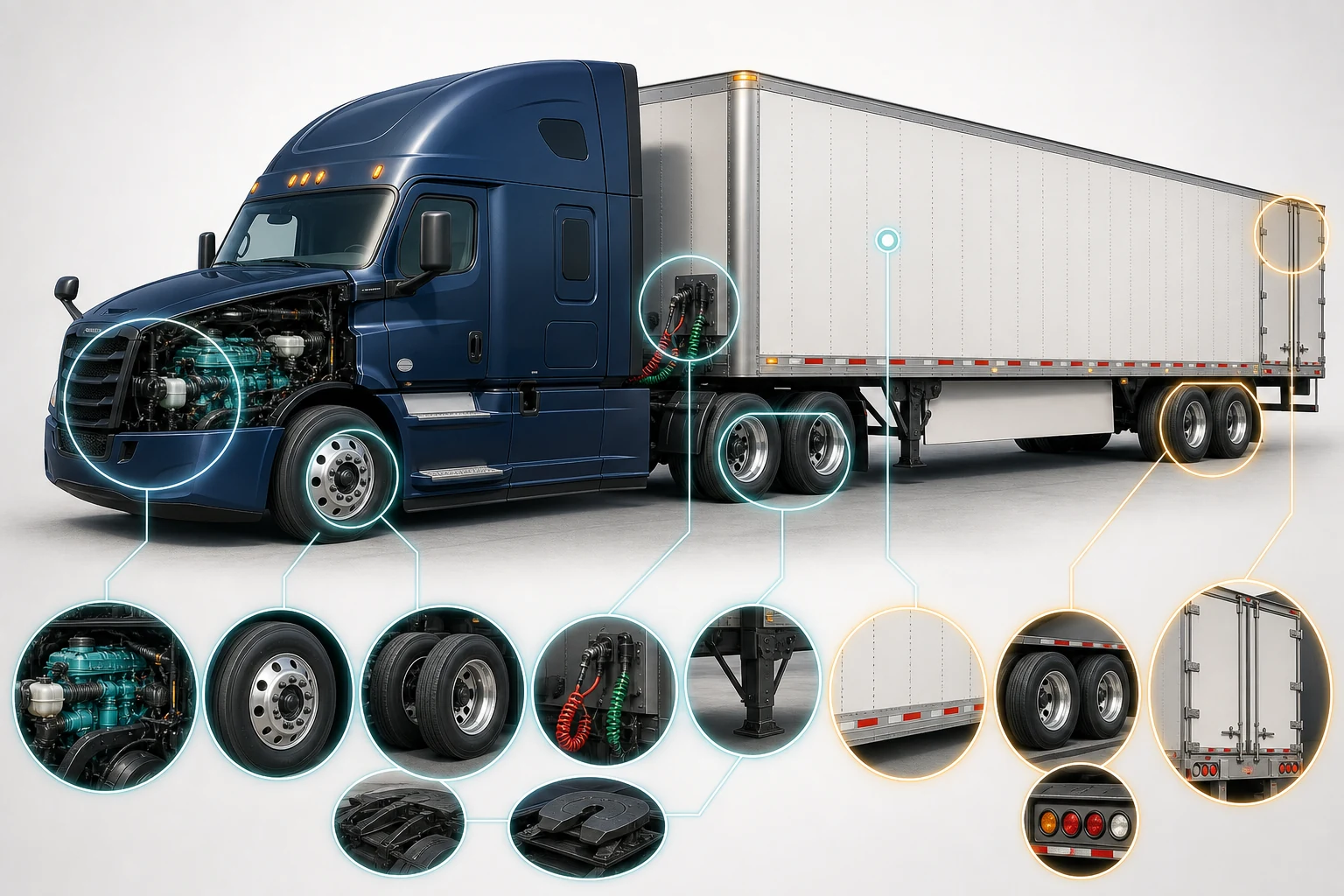
A tractor-trailer contains many systems that have to work together. Tires need to support tens of thousands of pounds. Brakes need to stop a heavy combination vehicle. The fifth wheel has to remain securely connected to the trailer. Air lines need to maintain pressure. Lights need to make the truck visible to other road users, and steering and suspension components need to function correctly throughout the trip.
A defect in any of these areas can create problems quickly.
For example, a driver might notice a tire with a deep cut during the inspection. Replacing that tire at a terminal is inconvenient, but it is much easier than experiencing a tire failure at highway speed. A driver may find an air leak while parked and have maintenance repair it before departure instead of losing air pressure several hours later. A missing trailer light can be corrected before the truck reaches a roadside inspection.
Federal rules reflect this basic principle. Under 49 CFR 392.7, a commercial motor vehicle should not be driven unless the driver is satisfied that required parts and accessories are in good working order. The minimum areas identified by FMCSA include service and parking brakes, steering, lights and reflectors, tires, horn, windshield wipers, mirrors, coupling devices, wheels and rims, and emergency equipment.
Another important rule appears in 49 CFR 396.13. Before operating a commercial vehicle, the driver must inspect it and be satisfied that it is in safe operating condition. If a previous vehicle inspection report identified defects, the driver must also make sure the necessary repairs were addressed before operating the vehicle.
The purpose is not to guarantee that a truck will never break down. Mechanical problems can still develop during a trip. The purpose is to catch problems that can reasonably be identified before the truck moves.
Is a Pre-Trip Inspection Required by Law?
Yes. Federal regulations place clear responsibilities on commercial drivers regarding vehicle condition before operation.
FMCSA guidance explains that drivers must be satisfied that both the power unit and trailer are safe before operating a combination vehicle. In other words, inspecting only the tractor and ignoring the trailer is not enough when you are operating a tractor-trailer combination.
This is important for drivers working drop-and-hook freight.
Imagine that you inspected your tractor in the morning and then arrived at a distribution center to pick up a different trailer. The fact that your tractor was inspected earlier does not mean you should simply connect to the new trailer and leave. That trailer has its own tires, brakes, lights, suspension, doors, landing gear, air connections, and other components that need attention.
Drivers also sometimes confuse a pre-trip inspection with a written Driver Vehicle Inspection Report, commonly called a DVIR.
They are related, but they are not exactly the same thing.
FMCSA guidance specifically states that §392.7 does not require a driver to prepare a written report simply because a pre-trip inspection was performed.
For most property-carrying commercial vehicles, federal DVIR rules also no longer require a no-defect written report at the end of every day. FMCSA explains that, outside certain passenger-carrying operations, a report generally needs to be submitted when a defect or deficiency affecting safe operation has been found or reported.
Your employer may still require electronic inspection forms or additional documentation as part of company policy, so drivers should follow both applicable regulations and carrier procedures.
What Should You Check During a Pre-Trip Inspection?
A good inspection follows a consistent pattern so that important areas are less likely to be forgotten.
Many drivers develop their own routine after gaining experience, but the fundamental areas remain similar. The inspection normally starts with the tractor and progresses around the vehicle until the driver has checked the major systems, the tractor-trailer connection, and the trailer.
The goal is not simply to say the names of the components, as you might during CDL training. The goal is to understand what can go wrong and what signs indicate a problem.
For example, checking a tire does not mean glancing at it for two seconds. You are looking for damage, unusual wear, low inflation, objects in the tire, or other conditions that could make it unsafe.
Checking a fifth wheel means verifying that the tractor and trailer are actually coupled correctly.
Checking lights means confirming that they are secure, reasonably clean, and functioning.
Once a driver understands what each component does, the inspection becomes much more logical.
Start by Looking at the Truck as a Whole
Before opening the hood or kneeling beside the tires, take a moment to look at the entire vehicle.
Does anything appear unusual?
Is the truck leaning heavily to one side? Is there a puddle underneath the engine? Does one tire appear noticeably lower than the others? Is part of the trailer damaged? Is the vehicle sitting differently than it did yesterday?
A general walk-around can reveal problems before you begin inspecting individual components.
Look underneath the tractor and trailer for obvious leaks. Depending on the location and equipment, leaking fluids could involve engine oil, coolant, fuel, power-steering fluid, hub oil, or another vehicle system.
Not every liquid beneath a truck automatically indicates a mechanical failure. Water from air-conditioning condensation, for example, may be normal. But an unexplained leak deserves attention.
Also look for visible body damage, objects beneath the vehicle, loose equipment, or anything that could interfere with driving.
Developing the habit of looking at the entire truck first can make smaller abnormalities easier to notice.
Checking the Engine Compartment
For conventional tractors, opening the hood gives the driver access to several important components.
Fluid levels are an obvious place to begin. Depending on the truck and manufacturer procedures, drivers may check engine oil, coolant, power-steering fluid, and windshield-washer fluid. The engine compartment should also be inspected for evidence of leaking fluids.
Visible hoses should be checked for obvious damage, leaks, swelling, or loose connections. Belts should not appear excessively worn, frayed, or damaged.
Drivers should also look at accessible steering and suspension components. Parts should appear secure and should not show obvious cracks, missing hardware, or severe damage.
The exact layout differs from one truck model to another, which is why new drivers should become familiar with the specific equipment they operate.
You may have learned on one tractor at CDL school and then be assigned a completely different model at your first carrier. The basic systems remain similar, but their location and appearance can change.
Do not assume that because the truck starts normally, everything under the hood is fine.
A small coolant leak or damaged belt may not prevent the engine from starting in the morning, but it can become a major problem after several hours of driving.
Tires, Wheels, and Rims Need Careful Attention
Tires are among the most important items to inspect because they support the truck's weight and operate continuously at highway speeds.
Drivers should look at tread condition, sidewalls, inflation, and signs of damage. Cuts, bulges, exposed material, unusual wear, or embedded objects can indicate a problem. Tires in dual assemblies also need to be inspected carefully, including the inner tire that may be harder to see.
Do not judge pressure only by kicking the tire. Follow appropriate company and manufacturer procedures and use proper equipment when an accurate pressure check is needed.
The wheels require attention too.
Look for obvious cracks, bends, or other damage. Lug nuts should be present and secure. Rust trails around wheel fasteners can sometimes indicate movement and deserve closer investigation.
Hubs and seals should not show obvious signs of leaking lubricant.
During the inspection, compare similar components. If nine tires look normal and one looks noticeably different, there may be a reason.
A careful driver learns to notice those differences.
Brake Systems Are Critical
A tractor-trailer may weigh close to 80,000 pounds in a common Interstate configuration, and bringing that weight to a controlled stop depends heavily on the braking system.
That makes brakes one of the most important parts of any pre-trip inspection.
FMCSA specifically includes service brakes, trailer brake connections, and the parking brake among the systems a driver must be satisfied are in proper working order before operating the vehicle.
Depending on the equipment and what can safely be inspected, drivers may examine accessible air lines, brake chambers, hoses, drums or discs, and related components. They should watch for damaged or loose parts, contamination, and audible air leaks.
Inside the cab, the driver also needs to pay attention to the air-brake system and warning devices. Air pressure should build and operate normally, and required warning systems should function properly.
The exact brake-test procedure used by your company or required for your equipment should be followed carefully.
A suspected brake problem is not something to postpone until the next maintenance interval. If a defect may affect safe operation, it should be reported and corrected before the truck is dispatched.
Lights, Mirrors, Windshield, and Visibility
A driver needs to see clearly and other road users need to see the truck.
During the inspection, check the vehicle's required lights and reflectors. This includes the tractor and trailer rather than only the headlights on the front of the truck.
Depending on the vehicle, you may need to verify headlights, turn signals, brake lights, tail lights, clearance lights, marker lights, and hazard lights.
A light can technically be functioning but still be difficult to see because it is covered in mud, snow, ice, or road grime. Keeping lights and reflective material clean can be particularly important during poor weather.
Mirrors should be secure, clean, and adjusted correctly. A loose mirror can become much more than an inconvenience when trying to change lanes or back a trailer.
Inspect the windshield for damage and make sure visibility is not significantly obstructed. Windshield wipers should function correctly, and drivers should have sufficient washer fluid for expected conditions.
A worn wiper blade may seem like a small maintenance issue on a sunny morning. Several hours later in heavy rain, it can become a serious visibility problem.
Inspect the Fifth Wheel and Tractor-Trailer Connection
For tractor-trailer drivers, the coupling system deserves special attention.
A trailer that is not properly connected can separate from the tractor, so drivers need to verify the coupling rather than assuming that hearing the fifth wheel lock means everything is correct.
Inspect the fifth wheel area and make sure the trailer is seated correctly. The locking mechanism should be properly engaged around the kingpin, and there should not be an obvious gap between the fifth wheel and trailer apron.
The release handle should be in the appropriate locked position.
Check the air lines and electrical connection between the tractor and trailer. Connections should be secure, and the lines should have enough clearance that they will not be pulled tight, pinched, or dragged against the equipment during turns.
The landing gear should also be inspected and fully raised before driving.
Drivers commonly perform an appropriate tug test after coupling to help verify that the trailer is securely connected, following their training and company procedures.
Coupling inspections are especially important after a drop-and-hook. Never assume the previous driver left the trailer ready for you.
Inspect the Trailer, Not Just the Tractor
A common beginner mistake is spending most of the inspection around the tractor and treating the trailer as an afterthought.
The trailer may have been used by several other drivers before you ever saw it. It may have traveled hundreds or thousands of miles since the last time you handled it.
Walk around it carefully.
Check the trailer tires, wheels, suspension, brakes, lights, reflective material, landing gear, frame, doors, and visible structural components.
For a dry van, look for obvious holes or damage that could allow water into the cargo area. Check rear doors, hinges, and latches.
A reefer driver will have additional responsibilities related to the refrigeration unit, fuel, trailer condition, and shipment temperature requirements.
Flatbed operations require much more attention to cargo securement equipment and the load itself.
FMCSA guidance is clear that a driver operating a combination needs to be satisfied that both the power unit and trailer are in safe operating condition.
Cargo Is Also Part of Pre-Departure Safety
Vehicle condition is only part of the inspection before departure. The load also matters.
FMCSA regulations require cargo to be properly distributed and adequately secured before the vehicle is driven.
The amount of direct access a driver has to the freight depends on the operation. A sealed dry-van load may prevent the driver from physically inspecting every pallet after the shipper closes the trailer. Flatbed cargo, on the other hand, is exposed and requires direct inspection of securement systems.
Drivers need to follow the requirements applicable to their cargo and operation.
Weight distribution matters as well.
A truck can be under the general 80,000-pound federal Interstate gross limit and still have too much weight on an individual axle group. When carrying a heavy shipment, drivers may need to scale the truck after loading and adjust trailer tandems or have freight repositioned.
A pre-trip is therefore not only about whether the truck can mechanically move. The driver must consider whether the entire combination is ready to operate safely and legally.
Check Required Emergency Equipment
FMCSA also requires drivers to be satisfied that required emergency equipment is available and ready for use before operating the vehicle.
For many commercial vehicles, this includes items such as a properly rated fire extinguisher and warning devices for a stopped vehicle. Spare fuses may also be required in applicable equipment unless the vehicle uses circuit breakers or other qualifying systems.
Company equipment may go beyond federal minimum requirements.
A carrier may provide reflective vests, flashlights, additional warning devices, basic tools, or other items intended for roadside situations.
Do not wait until you are stopped on the shoulder at night to discover that required equipment is missing or unusable.
What Should You Check Inside the Cab?
The exterior inspection gets a lot of attention, but drivers also need to evaluate the cab and vehicle controls before moving.
Start by making sure the driving position is properly set up. Adjust the seat and mirrors so you have good visibility and control.
When the truck is started, pay attention to dashboard warning lights and gauges. Air pressure, engine oil pressure, coolant temperature, fuel level, DEF level, and other vehicle-specific information can help reveal problems.
Check that the horn operates and that windshield wipers and washers work correctly.
The service brake and parking brake systems should be tested according to proper procedures. Drivers operating air-brake vehicles should know how to verify that the system builds and maintains pressure correctly and how to identify warning conditions.
The steering should not show abnormal looseness or behavior.
Seat belts should also be functional and accessible.
New drivers sometimes become so focused on completing an exterior checklist that they forget that several important safety checks happen from the driver's seat.
What Happens if You Find a Problem?
Finding a defect during the pre-trip inspection does not automatically mean the entire trip is canceled.
The appropriate response depends on the problem.
A minor issue may be repaired quickly by maintenance. A burned-out light could potentially be replaced before departure. A tire may need to be changed. A trailer with a serious defect may be removed from service and replaced with another trailer.
What matters is whether the condition affects safe or legal operation.
Under 49 CFR 396.13, the driver must be satisfied that the vehicle is in safe operating condition before driving it. If a previous inspection report contains a defect affecting safe operation, the driver must review the report and ensure that required corrective action has been taken.
The wrong approach is noticing a potentially serious problem and deciding to "see if it gets worse."
Mechanical problems usually do not improve after several hundred highway miles.
Report defects according to company procedures and allow qualified maintenance personnel to determine the appropriate repair when necessary.
Pre-Trip Inspection vs. Post-Trip Inspection
Pre-trip and post-trip inspections serve related but different purposes.
The pre-trip inspection asks:
Is this truck safe and ready to operate now?
The post-trip process focuses on identifying defects or problems that developed or became apparent during the work period so they can be addressed before the vehicle is used again.
Federal DVIR requirements have changed over time, which can cause confusion among new drivers. FMCSA eliminated the federal requirement for most property-carrying drivers to submit and carriers to retain a written no-defect DVIR. Under current federal guidance, those drivers generally submit the report when they find or have been made aware of a defect that could affect safe operation; passenger-carrying operations have different reporting requirements.
Companies can still require their drivers to complete electronic or written inspection reports more frequently than the federal minimum.
The important practical connection is that if the previous inspection identified a problem, the next driver needs to know whether it has been repaired before taking the vehicle onto the road.
A Pre-Trip Is Different From an Annual DOT Inspection
Another common misunderstanding is believing that a truck does not need much daily attention because it recently passed an annual inspection.
These inspections serve very different purposes.
Federal regulations generally require applicable commercial vehicles to undergo a periodic inspection at least once every 12 months.
That inspection is much more detailed and is performed by a qualified inspector.
A pre-trip inspection is performed by the driver before operating the vehicle.
Passing an annual inspection six months ago does not guarantee that nothing has broken since then. Tires wear, lights fail, air lines develop leaks, windshields crack, and other problems can appear at any time.
The annual inspection provides periodic verification of vehicle condition.
The pre-trip inspection helps determine whether the truck is safe today.
How Long Should a Pre-Trip Inspection Take?
There is no single amount of time that works for every inspection.
The time required can vary depending on the truck, trailer, weather, condition of the equipment, type of freight, and whether the driver discovers anything unusual.
A clean tractor and empty trailer in good condition may be inspected more efficiently than a loaded flatbed with multiple securement points or a truck operating during severe winter conditions.
What matters is not whether the inspection takes exactly 10, 15, or 30 minutes.
What matters is whether it is thorough enough for the driver to reasonably determine that the vehicle is safe.
Rushing because the shipper is waiting or because dispatch wants the truck moving can defeat the purpose of the inspection.
At the same time, experience usually makes drivers more efficient. A beginner may need more time because they are actively thinking about every component. An experienced driver often follows the same sequence automatically and knows where to look for common problems.
Efficiency is useful.
Skipping important checks is not.
Why New Drivers Sometimes Struggle With Pre-Trip Inspections
CDL students often learn the pre-trip inspection as a long sequence of phrases.
They may memorize statements such as:
"Properly mounted and secured."
"Not cracked, bent, or broken."
"No abrasions, bulges, or cuts."
That approach can help during the licensing process because students need to demonstrate knowledge to an examiner.
But once you are working professionally, the inspection becomes much easier when you stop thinking of it only as memorized language.
Ask yourself what each component actually does.
Why do you inspect the fifth wheel? Because you need the trailer to stay attached.
Why inspect tires? Because they must safely support the vehicle and maintain contact with the road.
Why inspect lights? Because other road users need to see what the truck is doing.
Why check air lines? Because the trailer's brake system depends on them.
Why look for fluid leaks? Because losing oil or coolant can damage the truck or create a breakdown.
Understanding the reason behind the check makes it much easier to remember the component and recognize a genuine defect.
Common Pre-Trip Inspection Mistakes
One common mistake is simply walking around the truck too quickly. A driver looks at the tires from several feet away, glances at the lights, and considers the inspection finished. That may miss the exact problems a proper inspection is intended to find.
Another mistake is inspecting the tractor carefully but barely checking the trailer. This is particularly dangerous in drop-and-hook operations where the driver may have no idea how the previous person treated the trailer.
Drivers can also become overly dependent on yesterday's inspection. A truck that operated normally the previous evening can still develop a leak, lose tire pressure, experience electrical problems, or be damaged while parked.
Ignoring small abnormalities is another problem. An unusual sound, fresh fluid underneath the vehicle, damaged tire, loose component, or warning light is information. It should be investigated rather than automatically dismissed.
Finally, do not treat the inspection as something done only to avoid a DOT violation.
The truck driver's first reason for inspecting the equipment should be much more immediate: you are the person who will be driving it at highway speed.
A Practical Pre-Trip Inspection Routine
Drivers should follow the procedures required by their employer and the specific equipment they operate, but having a consistent sequence helps prevent missed items.
A typical tractor-trailer routine may include:
- Review previous defect information when applicable.
- Look at the overall condition of the tractor and trailer.
- Inspect the engine compartment and visible fluid levels.
- Check steering-axle tires, wheels, brakes, steering, and suspension.
- Inspect the cab controls, warning systems, mirrors, windshield, horn, and wipers.
- Check drive tires, wheels, brakes, and suspension.
- Inspect the fifth wheel and tractor-trailer connections.
- Walk the trailer and check body condition, lights, tires, wheels, brakes, suspension, and landing gear.
- Inspect rear doors and required reflective equipment.
- Check cargo and securement when applicable.
- Verify required emergency equipment.
- Complete required brake and operational checks before entering traffic.
The exact sequence matters less than consistency.
If you follow the same logical pattern every day, it becomes much harder to accidentally skip an entire section of the truck.
Should You Perform Another Inspection During the Trip?
A pre-trip inspection does not mean you should ignore the equipment for the next 600 miles.
Professional drivers continue watching their vehicles throughout the day.
Fuel stops and rest breaks provide opportunities to walk around the combination and look for changes. A tire may lose pressure, a light may fail, a strap can loosen, or a new leak can appear after the morning inspection.
Cargo also has separate inspection requirements in applicable operations. Federal rules under §392.9 require certain cargo and securement checks after departure and during the trip, subject to the type of cargo and exceptions.
Experienced drivers develop a habit of looking at the truck whenever they stop.
You do not need to mentally restart the CDL exam every time you buy fuel, but taking a quick look at tires, wheels, lights, cargo, and the general condition of the vehicle can catch a developing problem before it becomes serious.
Why Pre-Trip Inspections Matter at Weigh Stations and Roadside Inspections
Drivers do not know when their truck may be selected for a roadside inspection.
A weigh station may allow you to continue through immediately, or an enforcement officer may direct your truck into an inspection area.
If the truck has a visibly damaged tire, defective light, brake problem, or other safety issue, an inspection can turn a normal trip into a significant delay.
More importantly, the defect existed whether an officer noticed it or not.
A good pre-trip inspection gives the driver an opportunity to find and correct many obvious problems before enforcement — or a breakdown — finds them instead.
This is another reason professional drivers often say that the best approach is to operate the truck as though it could be inspected at any time.
Frequently Asked Questions About Pre-Trip Inspections
Do Truck Drivers Have to Perform a Pre-Trip Inspection Every Day?
Before operating a commercial vehicle, the driver must be satisfied that it is in safe operating condition. In normal trucking operations, that means inspecting the equipment before taking it onto the road and reviewing prior reported defects when applicable.
Do You Have to Write Down Every Pre-Trip Inspection?
Federal guidance states that §392.7 itself does not require a written report simply because a pre-trip inspection was performed. Your carrier may still require electronic or written documentation.
Do You Need to Inspect the Trailer?
Yes. When operating a tractor-trailer combination, the driver must be satisfied that both the power unit and trailer are in safe operating condition.
What If Another Driver Already Inspected the Truck?
You are still responsible for being satisfied that the vehicle is safe before you operate it. If there was a previous inspection report noting defects, review the information and make sure required repairs were addressed.
Is a Pre-Trip the Same as a DOT Inspection?
No. A pre-trip is the driver's inspection before operating the vehicle. A roadside DOT inspection is performed by an authorized inspector, while a periodic inspection is a separate inspection generally required at least once every 12 months for applicable commercial vehicles.
Can You Drive if You Find a Defect?
It depends on the defect, but a vehicle must not be operated when the condition makes it unsafe. Report problems according to company procedures and have safety-related defects corrected before departure when required.
Final Thoughts
A pre-trip inspection is one of the most important routines in professional trucking.
It gives the driver an opportunity to find mechanical problems, equipment defects, coupling issues, tire damage, lighting failures, fluid leaks, cargo problems, and other safety concerns before the truck enters traffic.
A proper inspection covers much more than the tractor. The trailer, coupling system, required emergency equipment, and cargo also need attention when applicable.
For new CDL drivers, the process can initially seem complicated because there are many components to remember. With experience, it becomes much more natural.
The key is to stop thinking of the inspection as a script you memorized for the CDL exam.
Instead, think of it as answering one important question:
Is this truck, trailer, and load ready to travel safely?
Follow a consistent routine, take unusual conditions seriously, report defects when you find them, and never allow a delivery schedule to pressure you into ignoring an equipment problem.
A few extra minutes spent inspecting the truck before departure can prevent hours of roadside delays — and, more importantly, can help prevent a mechanical problem from becoming a safety emergency once you are on the highway.